
The best fun day activities in Singapore keep everyone moving at the same time, work at your venue and suit the youngest and oldest player in the group. Mobile laser tag does all three: we bring the equipment, the facilitators and the safety briefing to your condo, home, park, school or office, and games run for ages five and up. This guide shows how to choose activities for a children’s party, a team day or a carnival, with a plan, real numbers and a checklist.
TL;DR
- Pick the activity after you fix four facts: peak headcount, age range, venue and how long the active part lasts.
- Choose formats where everyone plays at once. Waiting in a queue is what makes a fun day feel flat.
- For kids’ parties, mix a main active game with short supporting games. For teams, use a mission format with sub-teams. For carnivals, run stations in parallel.
- Our laser tag sessions start at $30-35 per person for kids’ birthdays and $45 per person for Fun Shoot Outs, with a $200 booking deposit.
- Book early for peak periods, tell guests to wear covered shoes and comfortable clothes, and keep water within reach.
Fun Day Activities in Singapore: A Planning Guide
- Start with four facts, not a list of ideas
- Active games for kids’ birthday parties
- Fun day games that work for mixed ages
- Fun day activities for team building
- Carnivals and school events: run stations in parallel
- A quick comparison by occasion
- What our laser tag costs
- Bring the game to your venue
- Practical checks before the day
- Sample plans you can copy
- FAQ
- Sources
Start with four facts, not a list of ideas
Most lists of fun day ideas jump straight to games. A better order is to fix the constraints first, because they decide which games can work at all. Planners who run community events in Singapore suggest capturing four numbers before choosing anything: peak headcount (not total sign-ups), age range, venue type, and total run time including how much of it is active play.
Here is what each one rules in or out:
- Peak headcount. Twelve children in a condo function room and 150 staff at a family day need different formats. A game that serves six players an hour cannot entertain 150 people.
- Age range. Keep age bands tight where you can. A three-year-old and an eight-year-old want different things, and a wide range calls for a mix of adaptable activities rather than one game.
- Venue. Indoor air-conditioned space, a void deck, a school field and a park each have different limits on noise, power points, weather and space.
- Run time and active share. Two hours with 60 minutes of real play is a different plan from a four-hour carnival.
Write these on one line before you call anyone. It makes every quote and every suggestion easier to judge.
Active games for kids’ birthday parties
For children, an active party works best with a simple structure. One Singapore sports-party guide suggests a warm-up of 10 to 15 minutes, a main activity block of 30 to 40 minutes, a team challenge of 15 to 20 minutes, and a 15 to 20 minute cool-down with cake and celebration. That adds up to roughly two hours, which suits most home and condo parties.
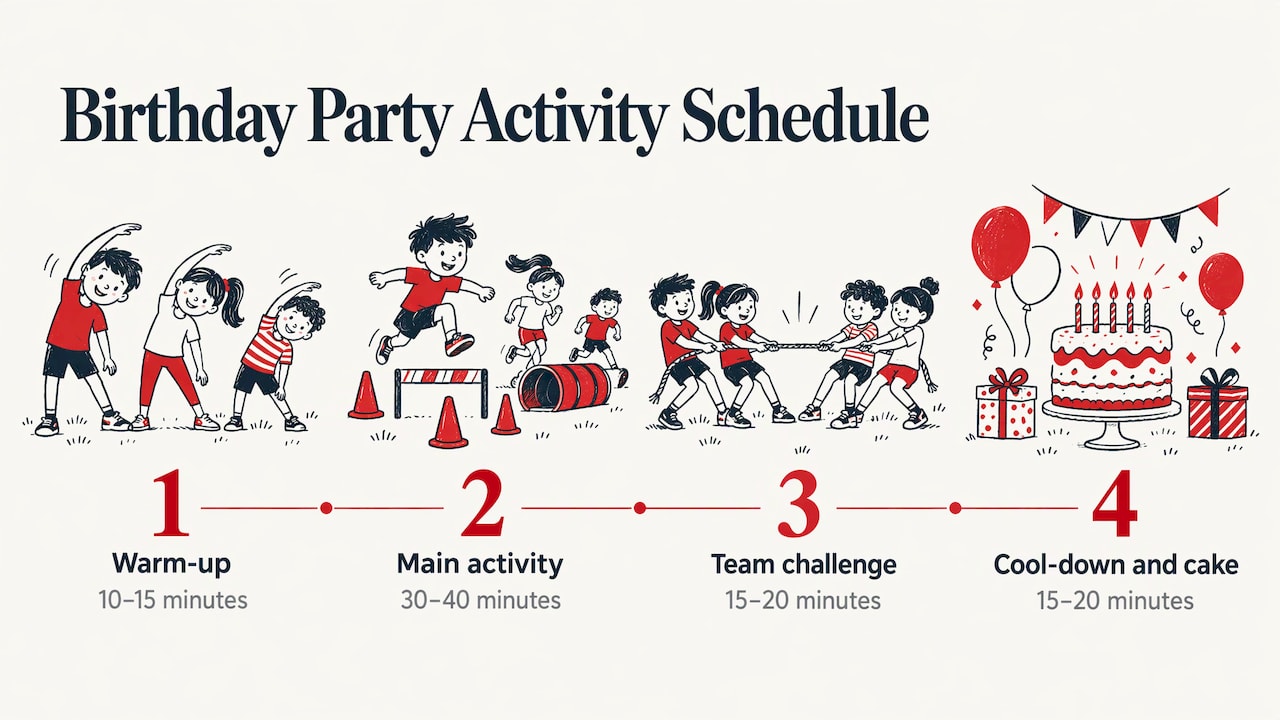
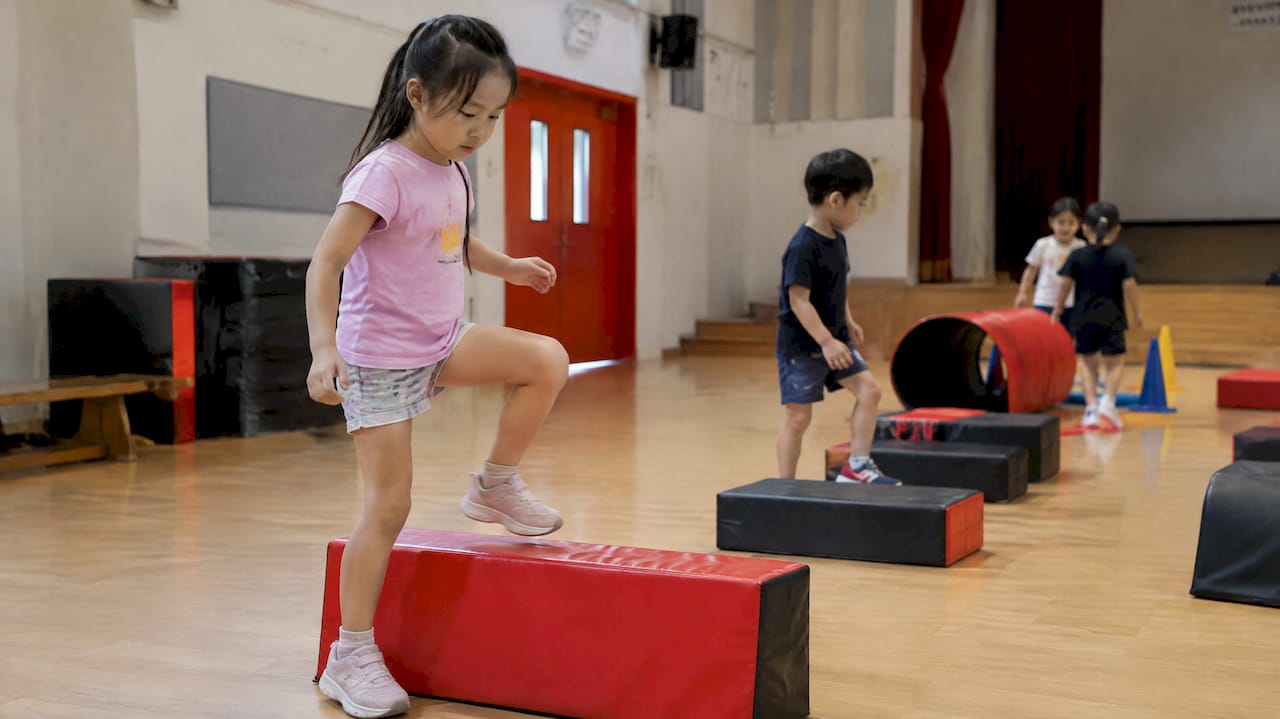
The same guide lists the kinds of games that fill those blocks: soft obstacle courses, parachute games, ball-skills stations, dance and movement games, mini Olympics, football challenges, dodgeball and team relays.
Where laser tag fits
Laser tag is a natural main activity block. Players move, hide, plan and cooperate, and the game has a clear story. Our games use non-contact infrared technology, so there is no physical contact, and children from age five upwards can join. We customize the format for age, group size, theme and mission, so a group of six-year-olds and a group of twelve-year-olds do not play the same game.
Themes are what turn a game into a party. See the themed laser tag parties for options, or browse kids’ laser tag party themes and ideas if you want inspiration before choosing a mission.
Supporting games for the in-between minutes
Children arrive at different times and tire at different rates. A few small games cover the gaps:
- Ring toss works from around age 4, and a duck pond booth suits ages 2 to 6, which helps with younger siblings who come along.
- Obstacle inflatables are the step up from bouncy castles for children aged roughly 6 to 14, according to the same family-activity guide.
- Relay races and tug-of-war need no equipment and let the whole group take part.
If your party uses our laser tag, you can add inflatable obstacles to the field. We rent 4 small inflatable obstacles for $100, 8 small ones for $150 and 1 big inflatable obstacle for $50, and an additional set of 5 tents for $100.
Fun day games that work for mixed ages
Family days and carnivals bring a hard problem: a four-year-old, a teenager and a grandparent in the same space. The answer is a mix of formats, not a compromise game.
- Skill games with a handicap built in. Giant Jenga and ring toss let a seven-year-old play against a parent, because the challenge is accuracy and not strength.
- Team games that adults enjoy. Tug-of-war is the standard example. Mixed generations on each side make it fun for everyone.
- Mission-based games. In laser tag, you can give young players roles such as medic or scout and let older players take on harder objectives. Everyone is useful, and no one sits out.
- A signature activity with smaller side attractions. Event planners often suggest one headline activity, several food stations and a cluster of game booths so the room is never waiting on a stage programme.
For family-oriented formats, our page on family laser tag experiences in Singapore explains how children and adults can play the same mission together.
Fun day activities for team building
A corporate fun day has a different goal: people from different departments should end the day knowing each other better. That points to activities with shared objectives, short rounds and time to talk between them.
Good team fun days tend to include:
- Sub-team missions. Split the group into squads of 5 to 8, each with a leader chosen on the spot. Rotate leaders between rounds.
- Rounds of different types. Combine an elimination game with an objective game, such as capturing a base or protecting a VIP, so different strengths get used.
- A debrief. Ten minutes after each round to ask what worked, who made the decisions and what to change.
- Parallel play for big groups. For groups above roughly 50, planners recommend running simultaneous heats or sub-teams so the event scales and no one waits.
Our corporate team building sessions run on this kind of mission format, with facilitators who run the game and the safety briefing. For what the games do for a team, see the team-building benefits of laser tag and how laser tag builds workplace unity.
A useful split for a half-day team event is a 60 to 90 minute main game block, a break with food and a lighter second activity. People are tired after intense play, so the second activity should be social, not competitive.
Carnivals and school events: run stations in parallel
Schools and companies that organise carnivals face a crowd problem. The goal is that most guests are playing most of the time. That means stations that run simultaneously, not one stage activity.
Two planning ideas help:
- Estimate each game’s capacity. Ask how many people each game serves per hour, then divide your peak headcount by that figure to see how many stations you need. If you cannot add stations, limit each person to one attempt.
- Mix skill and luck games. Ring toss, can knockdown and basketball shootouts reward skill. Duck pond and pop-the-balloon darts suit younger children. With 4 to 12 booths, hundreds of guests can play at once.
A laser tag mobile maze can be one of the signature attractions in that mix, with small groups moving through in rounds while other guests use the booths. Our carnival and event laser tag page covers the setup, and why laser tag suits school celebrations explains how it fits into a larger programme.
For school carnivals specifically, a practical guide for Singapore schools recommends confirming outlet locations and cable runs, planning for weather, marking queue lines, fencing soft-play areas and allocating 1 to 2 teachers or parent volunteers per station.
A quick comparison by occasion
| Occasion | Best format | Group size | What to prioritise |
|---|---|---|---|
| Kids’ birthday at home or condo | Themed mission game plus 1 or 2 small games | 8 to 25 | Tight age range, 2-hour flow, cake break |
| Teen party | Objective-based laser tag, relays | 10 to 30 | Variety of rounds, team scores |
| Corporate team day | Sub-team missions with debriefs | 20 to 100+ | Parallel play, rotating leaders |
| School carnival | Stations plus one signature attraction | 100 to several hundred | Queue lines, volunteers, weather plan |
| Family day | Mixed-age games and a mission game | 50 to 300 | Games for all ages, food, shade or indoor backup |
These are planning ranges to adapt, not fixed rules. Your four facts decide the rest.
What our laser tag costs
Our published rates are per person. Kids’ birthday parties are $30-35 per person, and Laser Tag Fun Shoot Outs are $45 per person. A $200 booking deposit confirms the event. Rental of inflatable obstacles and tents is priced separately, as listed above. Themed parties, corporate team building and carnivals do not have a published price, so we quote them from your headcount, venue and session length. The full list is on our game prices page.
Bring the game to your venue
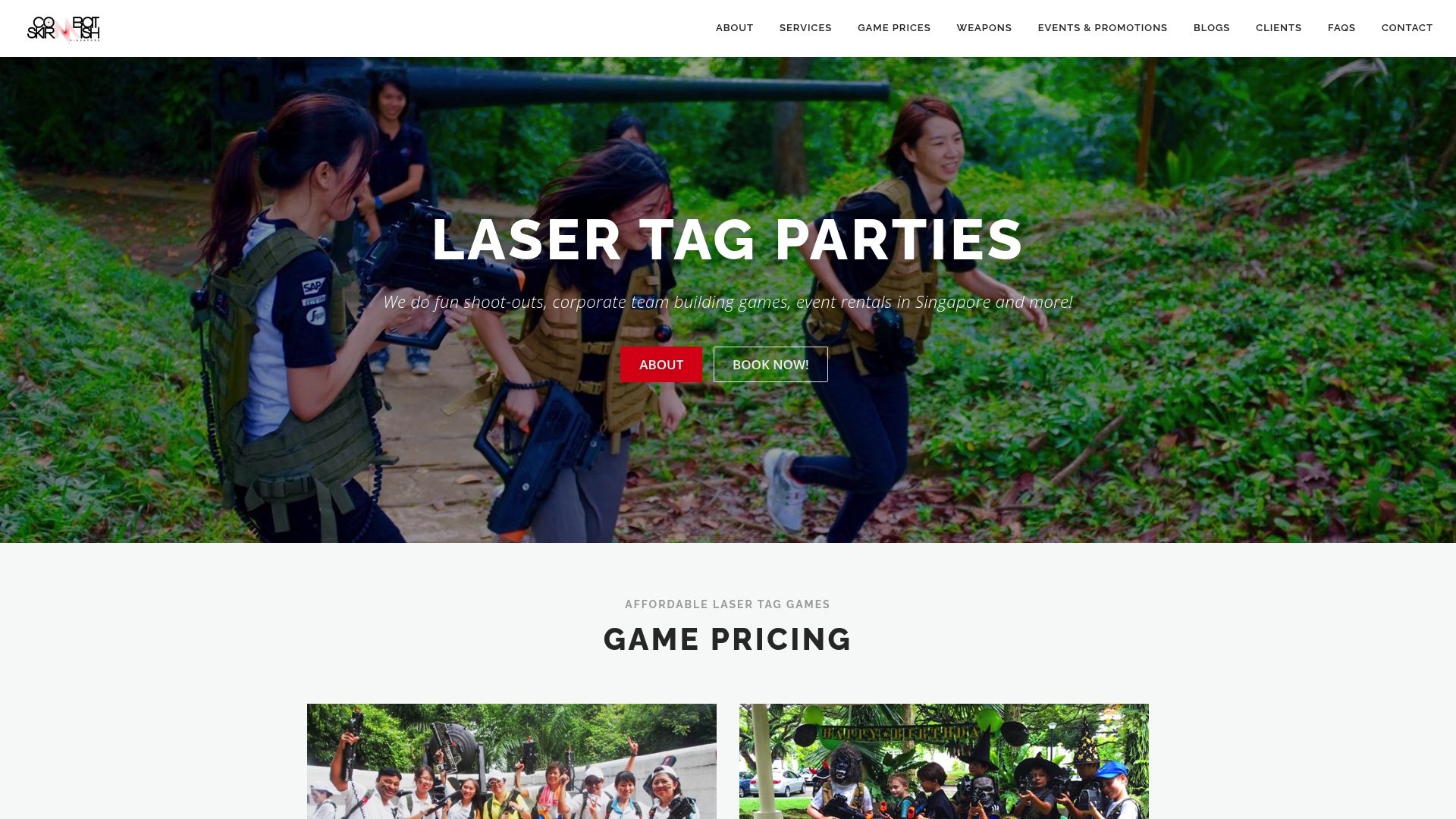
We have run mobile laser tag since 2005. We come to the venue you choose, whether condo, home, park, school or office, and bring all the equipment, setup, facilitators and safety briefings. You decide the age group, theme and mission format, and we shape the game around it. That leaves you with the guest list and the food, not the logistics of a game.
For a birthday, start with our laser tag birthday party page. For a carnival or team day, tell us your headcount, venue and run time and we will build the format. You can reach us through the Combat Skirmish Singapore site.
Practical checks before the day
A fun day goes well when the small things are settled. Use this list:
- Book early. One Singapore event company recommends 4 to 6 weeks ahead for standard corporate events and 8 to 12 weeks for large family days and peak periods. School holidays and year-end are busy, so book before you send invitations.
- Tell guests what to wear. Ask children to arrive in comfortable clothes and appropriate footwear, and do not skip the warm-up.
- Keep water close. Have water and light snacks ready and keep water accessible throughout, not just at the end.
- Check the venue. Confirm power points, shade or an indoor backup for rain, and space. Most carnival games need about 2 m by 2 m up to 3 m by 4 m of open space each.
- Confirm approvals. For condos, schools and offices, ask the management for any rules on outdoor activities, noise and equipment before you confirm.
- Consider event liability cover. For larger events, an organiser can buy a plan such as Income Insurance’s Event Liability Plan, which covers accidental bodily injury and property damage from negligence at indoor and outdoor events in Singapore. Check the terms for your event size and dates.
If a child has a medical condition such as asthma or an injury, speak to the parent or guardian before the party and agree what role the child will play in the games.
Sample plans you can copy
A two-hour birthday for 15 children aged 7 to 9
- 10 minutes: arrival, safety briefing and a short warm-up game.
- 45 minutes: laser tag missions in two teams, with a change of objective halfway.
- 15 minutes: water and snack break.
- 20 minutes: team relay or an obstacle challenge.
- 30 minutes: cake, photos and goodie bags.
A three-hour team day for 40 people
- 20 minutes: arrival and team assignment into five squads of eight.
- 20 minutes: briefing and practice round.
- 75 minutes: three mission rounds with a debrief after each.
- 30 minutes: break with food.
- 35 minutes: final round, scores and a short wrap-up.
A school carnival for 200 students
- Set up 6 to 8 game booths with queue lines marked and a volunteer at each.
- Place one signature attraction, such as a laser tag maze, in an area with room for waiting groups.
- Run in timed rotations by class so the crowd flows evenly.
- Leave a shaded rest area with water.
FAQ
What are good fun day activities for a mixed group of kids and adults?
Choose games where skill matters more than strength, such as ring toss, giant Jenga and tug-of-war, and add a mission game like laser tag where everyone has a role. Run them as stations so people can move between them at their own pace.
How many activities do I need for a fun day?
For a two-hour children’s party, one main activity and one or two short games is enough. For a carnival, plan one signature attraction and several booths, then size the number of stations by dividing your peak headcount by how many people each game serves per hour.
What age can children join laser tag?
Our games are designed for ages five and up and use non-contact infrared technology. We customize the game format for the age group, so younger children get simpler missions.
How far ahead should I book?
For standard events, 4 to 6 weeks is a common recommendation, and 8 to 12 weeks for large family days and peak periods. Our booking is confirmed with a $200 deposit, a headcount and a venue.
Sources
- Community Event Games in Singapore
- Birthday Party Entertainment Ideas: Sports and Active Options for Kids in Singapore
- Family Day Activities for Kids in Singapore
- Mid-Autumn Festival Celebration Singapore, event planning guidance
- Team-Building Activities for Large Groups: Planning Guide
- Carnival Games Singapore 2026: Booking Guide and Tips
- Children’s Day in Singapore: A Ready-to-Run Guide for Preschools and Primary Schools
- Frequently Asked Questions, Big Top Events
- Giant Fun Fair Games Rental
- Event Liability Plan, Income Insurance