
The best carnival activities for a Singapore event are the ones that keep every guest moving, let them play in teams and need very little space or queuing. A mobile laser tag game is the strongest anchor for that mix. It comes to your condo, school field or office, and it works for ages five and up. Around it you add a few low-effort stations, such as inflatable obstacles, tents for shade and a prize table, and you have a carnival that runs itself. We run laser tag events at any chosen venue, so this guide is written from the organiser’s side: what to include, how to match it to your group, and what to check before you open the gates.
Key Takeaways
- Build the carnival around one headline activity that a whole group can play at once, then add two or three smaller stations so nobody stands in a queue.
- Match the activity to the crowd: simple, short rounds for young children, team missions for schools, and objective-based games for company teams.
- A carnival open to the public in Singapore can need a fire-safety permit (TCOUP) from SCDF, and prize games can fall under public entertainment licensing. Check both early.
- Our published rates are $30-35 per person for kids birthday parties and $45 per person for laser tag fun shoot outs. Inflatable obstacles and tents are rented as add-ons.
- Decide headcount, venue and space first. Every other choice follows from those three numbers.
Carnival Activities in Singapore: Contents and Planning Guide
- What counts as a carnival activity in Singapore
- How the activity types compare
- Why a laser tag game anchors a carnival
- Matching activities to your group
- Choosing by headcount, space and goal
- Permits, safety and licences to check
- What carnival activities cost
- Book a carnival game your guests will talk about
- A sample carnival run sheet
- FAQ
- Sources
What counts as a carnival activity in Singapore
When readers search for carnival activities, they usually mean one of two things. Some want somewhere to take the family this weekend. Others are organising a carnival for a school, a company family day or a birthday and need things to put in it. This article is for the second group.
SCDF, Singapore’s civil defence force, defines a carnival as a public event or celebration that features entertainment, games, food or beverages. Its examples include fun fairs, amusement rides, circuses and festival celebrations. That is a broad definition, and it is useful because it tells you what a carnival needs at its core: something to play, something to eat or drink, and a reason to stay.
For most organisers the activity list falls into five groups:
- Team and action games. Laser tag, obstacle courses and capture-the-flag style missions.
- Skill booths. Ring toss, bean bag throws, balloon darts and similar stations where a player tries for a target.
- Chance games. Lucky draws, spin wheels and duck-pond style games where the prize is revealed at the end.
- Physical challenges. Inflatable obstacles, climbing and bell-ringing style games.
- Food, shade and rest. Snack stalls, tents and seating, which keep the other four groups running.
How the activity types compare
The table below helps you choose what to book first and what to fill the gaps with.
| Activity type | Best for | Space needed | Staffing | Queue risk |
|---|---|---|---|---|
| Mobile laser tag | Ages 5 and up, teams, mixed ages | Medium to large, indoor or outdoor | Facilitators run it | Low, whole groups play together |
| Inflatable obstacles | Children, school fields | Medium, outdoor or large hall | Light supervision | Medium |
| Skill booths | Younger children, casual guests | Small per booth | One person per booth | High at peak times |
| Chance games and lucky draws | All ages, fundraising | Very small | One person per station | Medium |
| Tents and rest areas | Hot afternoons, parents and elders | Small | None | None |
Notice the pattern. The activities with the lowest queue risk are the ones where many people play at the same time. That is why a group game works well as the centrepiece, while single-player booths work better as supporting acts.
Why a laser tag game anchors a carnival
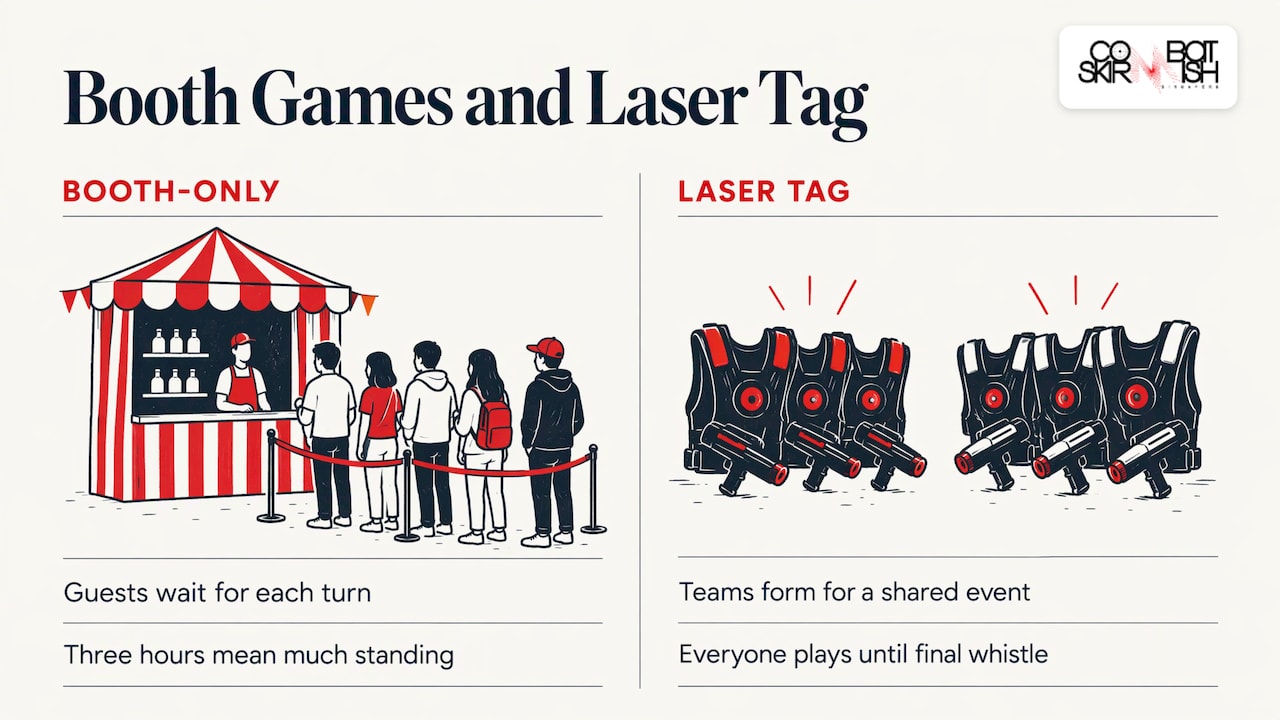
A carnival with only booths asks guests to wait for their turn at each one. Over three hours, that adds up to a lot of standing. A laser tag session turns the same time into a shared event: teams form, a mission begins, and everyone is playing until the final whistle.
Our games use non-contact infrared technology, so players tag each other with light rather than any physical object. That is how we can offer safe, inclusive play for all ages from five upwards. Games are customisable for age, group size, theme and mission format, so a session for primary school pupils can look quite different from one for a finance team.
We also bring the whole setup. Equipment, setup, facilitators and safety briefings are included, and events can be hosted at a condo, home, park, school or office. For a school carnival that means your teachers are not learning a game on the day. For a company, it means HR is not running equipment.
If you are planning a larger event, our carnivals and events page covers the formats we run, including the laser tag mobile maze. The laser tag games for carnivals and events page shows how they look on site.
Add-ons that make a carnival feel like one
A single game becomes a carnival when the space around it has things to do. We rent these add-ons, at the prices published on our game prices page:
- 1 additional set of tents (5 pieces): $100
- 4 small inflatable obstacles: $100
- 8 small inflatable obstacles: $150
- 1 big inflatable obstacle: $50
The tents give shade and a base for registration or a prize table. The obstacles give waiting players something to do and double as battlefield cover in some game layouts.
Matching activities to your group
The same list does not work for every audience. Here is how we would assemble it for each of the three groups who most often ask us.
Children’s birthday parties
Children aged five to eight have short attention spans and enjoy being told what to do in a clear, simple way. Choose rounds of a few minutes with a clear goal, such as defending a base or finding a hidden target. Theme matters a great deal at this age. A superhero or Minecraft mission keeps the same game fresh and gives guests something to talk about afterwards. See our themed birthday parties and the kids’ laser tag party themes for ideas.
Older children and teens want competition. Team scores, rankings and mission variety matter more to them than costumes. Our kids birthday parties are priced at $30-35 per person, and you can see how the package is laid out on the party pricing page.
For parents, the practical point is the venue. A condo function room or a void deck-adjacent space works if you have enough room, and you do not need to travel with a group of excited children. A $200 booking deposit confirms the date, as listed on our birthday parties page.
School carnivals
School carnivals have the widest age range and the largest headcount. The aim is usually to let as many pupils as possible take part within a fixed time slot, often between lessons or during a school event day.
That favours group activities. Run laser tag in rotating batches, with the inflatable obstacles and a few skill booths running in parallel, and you can cycle a whole level through without long waits. Keep the teachers’ role simple: check the headcount per batch and hand out wristbands or tickets. Our facilitators run the game itself, and games are customised for age and size, so Primary 1 and Secondary 3 pupils do not need to play the same one.
If the carnival is a fundraiser, put the chance games and food at the edges and the laser tag at the centre. That draws people through the whole space.
Corporate family days and team building
Company carnivals often mix employees, partners and families. The guest list may span toddlers to grandparents, so you need a spread: an activity for the competitive colleagues, one for the children, and a shaded area for everyone else.
For the team-building portion, choose a game with an objective that needs coordination, not just individual scoring. Missions that require teams to split roles, such as scouts, defenders and attackers, make people talk to colleagues they rarely work with. Our corporate team building page explains the formats, and the laser tag in the CBD page covers after-work sessions near the office. If budget is the first question, our guide to affordable laser tag team building is a good place to start.
Choosing by headcount, space and goal
Three questions narrow the list quickly.
How many people will play at once? Count the total guests, then decide how many you want playing simultaneously. A group of 20 can all play the same game. At 200, you need batches, and the batch size sets how many stations you need to keep the others occupied.
What space do you have? Measure it, including shade and walking routes. A carpark or field allows a larger layout, while a function room needs a compact one. Because we set up at your venue, the layout is built to suit the space, not the other way round. Tell us whether it is indoor, outdoor or mixed, and whether there is cover from rain, which in Singapore you should always plan for.
What should guests remember? If the goal is celebration, pick a theme. If it is bonding, pick objective-based missions. If it is fundraising, pick activities that keep guests on site longest and near your stalls.
A simple planning sequence helps:
- Set the headcount and the time slot.
- Confirm the venue and its rules, such as noise limits, power points and whether the space is sheltered.
- Choose one headline game and book it.
- Add two or three supporting stations that do not need many staff.
- Add shade, seating and water.
- Check permits and licences (see below).
Permits, safety and licences to check
A private party at home or in a condo function room rarely raises these questions. A carnival open to a wider crowd can. Check the following early, because some of them involve official lead times.
Fire safety permit (TCOUP)
SCDF requires a Temporary Change of Use Permit, called a TCOUP, for qualifying temporary changes of use involving carnivals. You apply through GoBusiness at least three working days before the event, and SCDF decides within three working days. Do not leave it to the last week, because your own planning may still need adjustments after the decision.
SCDF’s outdoor event conditions, updated on 20 March 2026, give figures that shape your layout:
- Booths no taller than 3 m.
- Booth rows no longer than 15 m and 6 m wide.
- Clear passageways of at least 1.2 m between rows.
- Single-storey tentages up to 2,000 sq m.
- Class ‘AB’ fire extinguishers every 15 m inside tentages.
- No open-flame cooking, such as blow torches.
- An onsite emergency response team for major events notified by SCDF.
Plan your tent and obstacle placement with these numbers in hand. Keep escape routes unobstructed at all times, including during queues.
Public entertainment licensing
Under the Public Entertainment Act 1958, which is in force from 1 May 2026, public entertainment includes organised competitions at games of skill or chance and machines that give chances of obtaining prizes. It must be provided only at an approved place and under a licence from the appropriate Licensing Officer. If you plan prize games for the public, confirm with the Licensing Officer whether your carnival needs a licence. A closed school or company event with invited guests is a different situation, so ask the venue and the authority for the answer that applies to you.
Safety on the day
For children’s events, assign adults to supervise each station and set one meeting point. Brief everyone before play begins. Our games include a safety briefing from the facilitators, and the infrared system means no physical contact is part of the game. Players still run, so choose flat ground, keep walkways clear and have water ready in hot weather.
What carnival activities cost
Costs vary widely, so set a per-head budget before choosing.
For reference, public carnivals charge by the game or ride. The Straits Times reported that at a Sanrio carnival at VivoCity’s Sky Park in September 2026, carnival games cost $10 each and train rides $10, with a toy capsule dispenser starting at $8. Pay-per-play adds up quickly for a family or a class.
An organiser who books a group activity pays per person for a fixed session instead. Our published rates, as listed on the site in November 2026:
| Package | Published price |
|---|---|
| Kids birthday parties | $30-35 per person |
| Laser tag fun shoot outs | $45 per person |
| Booking deposit | $200 |
| Additional set of tents (5 pieces) | $100 |
| 4 small inflatable obstacles | $100 |
| 8 small inflatable obstacles | $150 |
| 1 big inflatable obstacle | $50 |
Themed birthday parties, corporate team building, carnivals and events, and the laser tag mobile maze have no published price, so the quote depends on your headcount, venue and format. The full list is on our pricing page.
Book a carnival game your guests will talk about
If you are running a school carnival, company family day or large birthday, our laser tag setup can be the centrepiece. We bring the equipment, set up at your venue, provide facilitators and give the safety briefing, and we tailor the game to your age group, headcount and theme. Share your date, venue and headcount on our carnivals and events page and we will propose a format that fits.
For a smaller celebration, see our kids birthday party pricing, where the per-person rate and the deposit are laid out.
A sample carnival run sheet
Here is how a three-hour school or company carnival can run with about 120 guests, using batches to prevent queues.
- First 20 minutes: Registration under the tents. Guests split into four colour teams.
- Hours one and two: Two teams play laser tag while the other two rotate through inflatable obstacles and skill booths. Swap every 30 minutes.
- Last 30 minutes: A final all-teams mission, then prizes and food.
This kind of rotation is why group games beat booth-only carnivals. Everyone plays most of the time, and the number of staff you need is smaller.
FAQ
What are good carnival activities for a children’s birthday party?
Pick one group game and one or two simple stations. A themed laser tag mission suits children from age five, and a small inflatable obstacle gives guests something to do between rounds. Keep each round short and give every child a clear role.
Do I need a permit to hold a carnival in Singapore?
Possibly. SCDF requires a TCOUP for qualifying temporary changes of use involving carnivals, applied for through GoBusiness at least three working days before the event. Prize games for the public may also come under public entertainment licensing, so ask the Licensing Officer if your carnival is open to the public.
How do I stop queues at a school carnival?
Choose group activities where many pupils play at once, and run them in timed batches. Rotate classes between stations, and keep single-player booths as supporting stations rather than the main attraction.
Can carnival games be held at a condo or office?
Yes, as long as the venue allows it and you have the space. We host events at a condo, home, park, school or office, and we bring the equipment, setup, facilitators and safety briefing. Confirm the venue’s rules on noise, power and access first.
How much does a laser tag carnival activity cost?
Our published rates are $30-35 per person for kids birthday parties and $45 per person for laser tag fun shoot outs. Tents and inflatable obstacles are rented separately. Carnival and corporate events are quoted based on your headcount and venue.
Sources
- SCDF: Temporary Change of Use
- SCDF: Outdoor event fire safety conditions (updated 20 March 2026)
- Singapore Statutes Online: Public Entertainments Act 1958
- The Straits Times: Sanrio carnival and school holiday activities