
Laser tag has a short rulebook: tag opponents with an infrared beam, never touch anyone, keep your sensors uncovered and listen to the marshal. Scoring and objectives change with the game mode, which is why a good briefing matters more than memorizing anything. If you are planning a birthday party, a team-building session or a school carnival in Singapore, this guide covers the rules every game shares, how points work, the safety rules for children and mixed-age groups, what to wear and what to expect before the first round. Since 2005, Combat Skirmish has brought mobile laser tag to condos, homes, parks, schools and offices, with the equipment, setup, facilitators and safety briefing included.
Key Takeaways
- Every laser tag game rests on the same core rules: no physical contact, sensors stay uncovered, no aggressive running, and the marshal’s word is final.
- Scoring varies by mode and by system, so the briefing before the game is where the real rules for your session are set.
- For children under 12, a safe game needs enough adult supervision, clear boundaries and simplified settings.
- Closed shoes and comfortable clothes are all most players need.
- Teams that agree on the objective and share roles usually beat players who run around shooting alone.
Table of Contents
- What laser tag actually is
- The basic rules every game shares
- How scoring works
- Common game modes in plain English
- Safety rules for laser tag
- What to wear
- Beginner tips that make the first game better
- How a hosted event handles the rules for you
- Planning budget: what hosted laser tag costs
- Book a laser tag event with the rules taken care of
- Perspective
- FAQ
- Sources
What laser tag actually is
The Singapore Laser Association describes laser tag as a sport played between two or more teams in which players use a gun that fires an infrared beam at opponents’ equipment or targets. Players earn points and complete objectives by tagging each other and targets. The winner is the player or team with the most points.
The beam is harmless light that a sensor reads, not a projectile. That is why laser tag is called a non-contact activity: nobody gets hit with anything, so the game can be played by children and adults together. Our own sessions use non-contact infrared technology and are designed for players from age five upwards.
The typical kit is simple. A beginner’s guide lists a handheld gun that emits infrared, a vest with sensors, a scoreboard that tracks hits and eliminations, and sometimes sensors on a headband. More advanced systems add sound, lights and vibration when you are tagged. Rounds commonly run 10 to 15 minutes, so a party usually plays several games back to back.

The basic rules every game shares
Formats differ, but the conduct rules are nearly universal. Treat these as the house rules for any session:
- No physical contact. Match-running guidelines are blunt on this: any touching, bumping or hitting of people or equipment is grounds for immediate removal.
- Keep sensors exposed. Covering the sensors on your vest or gun with a hand, jacket or bag is cheating, and the same guidelines remove players who do it.
- No friendly fire. You tag opponents only. Know your team color before you move.
- Walk or jog, no sprinting. Avoid sharp turns and full-speed running, and wear your gear properly, as beginner safety tips advise.
- Respect the marshal. In a hosted game one person is the referee, and their decisions are final. Following their instructions at all times is the single rule that prevents most problems.
- Follow the arena’s own rules. Boundaries, out-of-bounds areas and restart points depend on the space you are playing in, whether that is a condo void deck, a school field or an office floor.
For a group of adults, these rules are quickly absorbed. For a group of eight-year-olds, the marshal should say them loudly, clearly and calmly, then repeat the two that matter most: no touching, no running.
How scoring works
There is no single scoring formula. The standard is that a successful tag on an opponent earns points, and in team games the team score is the sum of individual scores. Beyond that, systems differ.
One well-documented commercial system gives 10 points for a successful tag and takes points off when you are tagged, with the penalty depending on where you were hit: shoulders and laser minus 3, back minus 4, front minus 5. It also adds an accuracy bonus of 10 points per 1% hit rate, capped at 100 bonus points in solo games. The cap exists so that a player cannot tag someone once and then hide for the rest of the round.
Other systems are simpler. In one game mode used by equipment makers, players cannot be eliminated at all: each hit disables your gun for 3 seconds, a player hit scores 100 points and a target hit scores 50. That kind of “stun” mode suits young children well, because nobody sits out.
The practical lesson: do not assume the numbers you read online apply to your session. Ask the marshal how points are awarded, whether you can be eliminated, and how long a stun lasts.
Common game modes in plain English
The Singapore Laser Association notes that modes range from solo or team deathmatch to Capture the Flag and system-specific custom formats, which is why rules vary from venue to venue. These are the ones beginners meet most.
| Mode | Objective | Best for |
|---|---|---|
| Solo deathmatch | Score more points than every other individual | Mixed groups who want a quick warm-up |
| Team deathmatch | Your team’s combined tags beat the other team’s | Birthday parties and office groups |
| Team elimination | Take out every opposing player before time runs out, or lead on points when it does | Older kids and adults |
| Capture the Flag | Take the other team’s flag and return it to your base | Teams that want a plan |
| Mission or objective games | Complete themed tasks alongside tagging | Themed parties and corporate sessions |
In Capture the Flag, two teams each defend a base flag. A flag-carrier who is tagged must drop the flag where they fall, and the first team to return the enemy flag to its own base wins.
With team elimination, one reference scheme awards 100 points per hit and 200 for the last hit that takes a player out. The team that eliminates all enemies first wins, or the team with the most points if time expires.
Our games are customizable for age, group size, theme and mission format, so a party of seven-year-olds can play a themed mission while an office team plays a flag-based game in the same session.
Why teamwork decides most rounds
The players who win are rarely the ones who shoot most. Equipment-maker guidance on beginners points out that teams who understand the winning condition, plan before the round and assign roles, such as scout, side-watcher and leader, outperform lone shooters. On large fields they even use walkie-talkies.
For a company, that is the point of the exercise: the game forces people from different departments to communicate, reposition and cover each other. If you are choosing laser tag for that reason, our pages on laser tag team building benefits go deeper.
Safety rules for laser tag
Laser tag is a low-impact activity, but a group of excited players in a space with steps, furniture or uneven ground needs a few firm rules.
Briefing before every game. Organizer guidance states a safety briefing should be mandatory before every game, whatever the players’ experience. It should cover the features of the playing area, hazardous zones, starting points and emergency procedures. Our events include a safety briefing as standard.
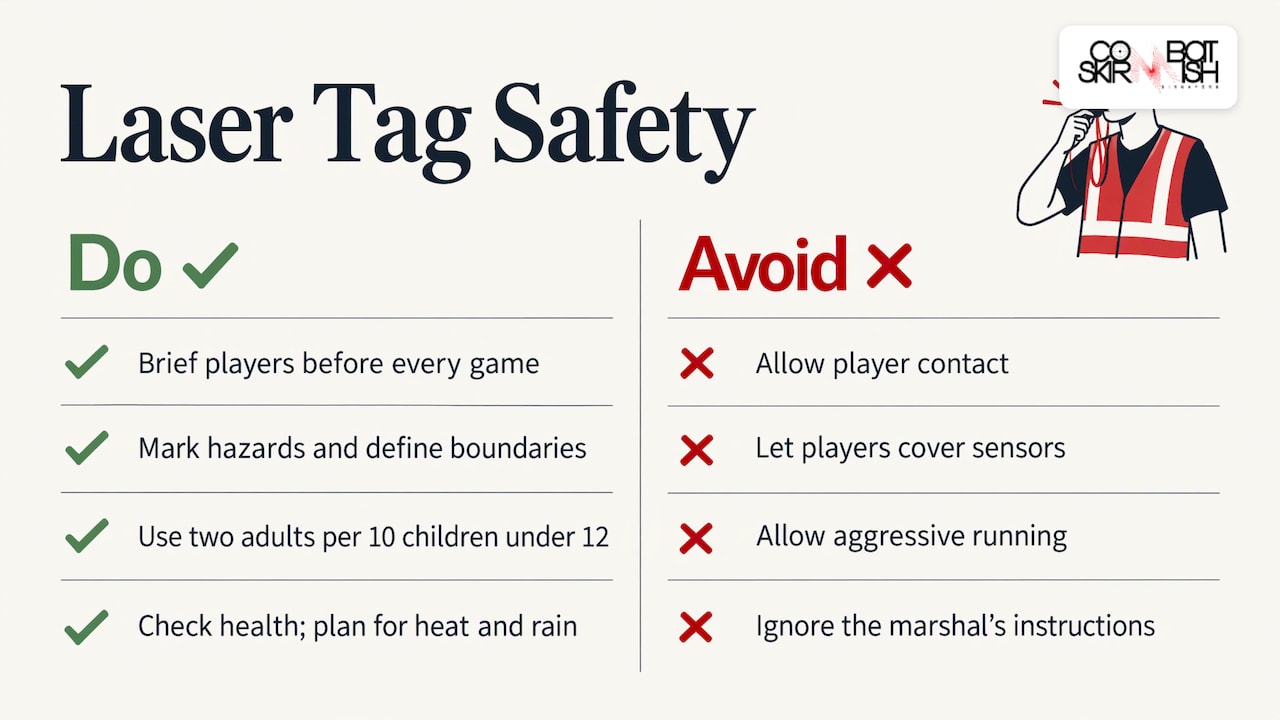
Define the space. Hazardous zones should be identified and either blocked off or isolated, and starting zones and organizer areas should be set out in advance. At a condo or school, that means walking the area first and marking out-of-bounds spots such as stairwells, pools, roads and glass.
Adult ratios for children. For participants under 12, the same guidance calls for at least two adult organizers per 10 children, simplified equipment settings, visible starting points, clearly defined boundaries and the parents’ contact details. At a birthday party, plan on parents staying nearby for the whole session.

Conduct rules. No contact, no covering sensors, no aggressive running and respect for opponents and staff. Anyone who ignores the marshal sits out a round, which is usually enough.
Health and comfort. Anyone with a medical condition, injury or mobility issue should check with their own doctor before joining an active game, and tell the marshal at the briefing. Children who tire easily can take breaks between rounds.
Weather and heat. For outdoor sessions in Singapore, schedule around the afternoon heat and rain, keep water available and plan an indoor fallback such as a covered area or void deck.
What to wear
Nothing special: comfortable clothes you can move in and closed shoes. Trainers or other closed footwear are the standard recommendation in beginner safety tips, because you will be moving quickly over varied surfaces. Sandals and slippers are the wrong choice. The vest goes over your clothes, so avoid bulky jackets that could cover sensors or make you overheat.
For the best experience:
- Wear light, breathable clothing, ideally in a color that will not clash with your team vest.
- Tie long hair back and leave dangling accessories at home.
- Bring a water bottle, especially for outdoor games.
- Leave phones and wallets with a parent or colleague, not in your pockets while you run.
Beginner tips that make the first game better
Listen first. The briefing is where you learn the scoring, the boundaries and how the equipment works. Players who skip it spend round one confused.
Learn your gun. Find where the trigger, the sensors and any reload or stun indicator are before the game starts.
Know the objective. If the aim is a flag or a mission, shooting is only half the job.
Use cover. Crouch behind obstacles and peek out to shoot. It beats standing in the open.
Talk to your team. Call out where opponents are. Even a two-word callout beats silence.
Pace yourself. Rounds are short, but a party may play many of them. Walk between fights and save your energy for the late rounds.
Play to have fun. For children especially, the best outcome is that everyone gets tagged and tags back. Mixed teams of different ages and abilities keep scores close.
How a hosted event handles the rules for you
The rules above are easy to read and hard to enforce when you are also the host. At a birthday party, the parent is busy with cake and guests. At a corporate event, the organizer is watching the schedule. A hosted session moves the rule-keeping to a facilitator.
At our events, all equipment, setup, facilitators and safety briefings are provided, and the game can be held at the venue you choose: condo, home, park, school or office. The facilitator explains the rules before play, and the game format is adjusted for the age and size of the group. For schools and companies running carnivals, we also offer a Laser Tag Mobile Maze as part of our carnival and event services.

Planning budget: what hosted laser tag costs
Prices as published on our site:
| Package | Price |
|---|---|
| Laser Tag Fun Shoot Outs | $45 per person |
| Kids Birthday Parties | $30-35 per person |
| Booking deposit | $200 |
| 1 additional set of tents (5 pcs) | $100 |
| 4 small inflatable obstacles | $100 |
| 8 small inflatable obstacles | $150 |
| 1 big inflatable obstacle | $50 |
Themed birthday parties, corporate team building and carnivals have no published price, so they are quoted on request based on headcount, venue and package length. See the full pricing page for the current list.
A quick example: a kids’ party for 15 children at $30 per person comes to $450 at the lower end of the range, and at $35 per person to $525. Add obstacle rentals if you want a more varied arena.
Book a laser tag event with the rules taken care of
If you are planning a party, a team session or a carnival, we bring the full setup to you: equipment, facilitators and the safety briefing, at the venue you pick. Games are customizable for age, group size, theme and mission format, for players from five upwards. Choose Kids Birthday Parties for children’s celebrations, Corporate Team Building for work groups, or Carnivals & Events for schools and organizers. A booking is confirmed with a headcount, a venue and a $200 deposit.
Perspective
After many years of running mobile laser tag, we have found that the rules rarely cause trouble. What causes trouble is the gap between reading the rules and having someone calmly enforce them while ten excited kids or thirty colleagues are running around.
That is why we bring the briefing and facilitators with the equipment. Players hear the rules at the venue, in the context of the actual space, whether that is a living room, a school field or an office floor. A rule like “stay out of that corner” only works when the corner is pointed out.
We also think customization is a safety feature as much as a fun one. A game for five-year-olds should look different from one for a sales team, in pacing, in objectives and in how boundaries are set. Non-contact infrared play makes that flexibility possible, and it is why one session can include everyone in the room.
If you take one thing from this guide, make it this: agree the objective, hear the briefing and keep your sensors clear. The rest is fun.
Joshua
FAQ
These are the questions parents and organizers ask most often about laser tag rules.
What are the basic rules of laser tag?
No physical contact, no covering your sensors, no friendly fire, no aggressive running and always follow the marshal. Points come from tagging opponents or targets, and the player or team with the most points wins. Scoring details depend on the game mode, so listen to the briefing.
Is laser tag safe for young children?
It is a non-contact activity, and our games are designed for players from age five upwards. Safe play for under-12s depends on adult supervision, clear boundaries, simplified settings and a proper briefing. Guidance for organizers suggests at least two adults per 10 children.
How long does a laser tag game last?
A single round typically runs 10 to 15 minutes. A party or team session normally plays several rounds in different modes, so the total depends on the package length you book.
What should I wear to laser tag?
Comfortable, breathable clothes and closed shoes such as trainers. Avoid sandals, bulky jackets and loose accessories, and bring water for outdoor games.
Do I need to know the rules before I book?
No. The facilitator explains the rules and safety points before play begins, and the format is adjusted for the age and size of your group. Beginners and first-time groups can join without any preparation.
Sources
- Laser Tag, Singapore Laser Association
- How to Play Laser Tag: A Complete Guide for Beginners
- Laser Quest, Wikipedia
- Laser Tag Games, Steradian Tech
- Beginners Guide to Laser Tag, Steradian Tech
- Running a Laser Tag Match: Rules, Guidelines & Game Ideas
- Organizing Safe Laser Tag Games, LASERWAR