
The best office team building games share three things: a clear goal, simple rules and no pressure to perform. Quick desk-side games cover the first 15 minutes of a meeting. For a team that wants to move, compete and laugh together, a mobile laser tag session is the game we recommend: everyone plays at once, nobody waits for a turn, and we bring it to your office, school or condo.
Key Takeaways
- A good team game has a clear goal, simple rules, low pressure to join in and a size that fits your team, according to G2’s guide to team-building games.
- Short games (5 to 20 minutes) suit meetings and Friday afternoons. Bigger groups need games where everybody plays at the same time.
- Laser tag works for adult teams, schools and event organisers because it scales from a small department to a large crowd and needs no experience.
- Our fun shoot-outs are $45 per pax. Corporate team building and carnival formats are quoted on request.
- We set up at your office, school, park or condo with equipment, facilitators and a safety briefing included.
Table of Contents
- What makes an office game worth playing
- Quick games for the office or meeting room
- Games that build communication and problem-solving
- Work party games for larger groups
- Why laser tag suits adult teams
- Choosing by headcount, time and space
- Planning for expat teams and families
- Planning for schools and event companies
- Our view on team games
- Book a session for your team
- FAQ
- Sources
What makes an office game worth playing
Most office games fail for one of two reasons. Either the rules take longer to explain than the game lasts, or somebody feels put on the spot. G2’s guide lists what the strongest games share: a clear goal, simple rules, low pressure to participate, and an adaptation to the team’s size and work setup. It also suggests that quick games fit under 30 minutes with little preparation, and that the organiser should close with one takeaway so the game connects back to work.
That last point matters more than it sounds. A game that ends with “that was fun” is pleasant. A game that ends with “what did we do when the plan fell apart, and what would we do on Monday?” is team building. Whatever you pick, decide beforehand what the team should walk away noticing: communication, trust between departments, or simply that colleagues enjoy each other’s company.
For Singapore teams there is a practical layer too. Offices here often mix nationalities, seniority levels and working styles. Many staff are expats who joined recently and have yet to meet people outside their own floor. A game that needs no cultural knowledge, no singing and no personal confessions includes everyone from day one.
Quick games for the office or meeting room
These need no equipment and work in a meeting room, a pantry or around desks. Keep each to ten minutes or so and always let people pass.
Two truths and a lie
Each person shares three statements about themselves, two true and one invented, and the group guesses the lie. It suits groups of roughly 4 to 15 and takes 10 to 20 minutes. Ask people to keep the facts light (a hobby, a first job, a country they have lived in). Newer colleagues often have the best stories.
This or that
Read out a two-way choice, such as kopi or teh, MRT or bus, mountains or beach. Everyone walks to one side of the room, and a volunteer or two explains the choice. It works for larger groups because everybody moves at once, and it takes five minutes.
Common ground
Split into groups of three or four and give them three minutes to find three things they all share that are not obvious: not “we all work here”. It mixes departments quickly, and the answers become small talk for the rest of the day.
Silent line-up
Ask the team to line up by birthday month, or by how long they have lived in Singapore, without speaking. They have to use gestures and organise themselves. It takes about ten minutes and gives a visible lesson in how teams create order without a manager.
These games are good warm-ups. They will not, on their own, give a team the shared story that lasts for months. For that, you need something where colleagues face a challenge together.
Games that build communication and problem-solving
When the aim is working better together rather than just meeting, pick a game with a task, a time limit and a debrief question.
- Tower challenge. Teams of four build the tallest free-standing structure from spaghetti, tape and string, with a marshmallow on top, in 18 minutes. The lesson is about testing early rather than planning one perfect design. It suits roughly 8 to 40 people and about half an hour.
- Blindfold guide. One person is blindfolded and guided through obstacles by a partner, first by voice only. It exposes how vague instructions are, and it suits groups of 6 to 24.
- Blind drawing. Pairs sit back to back, and one describes a picture while the other draws it. Run it once with no questions allowed and once with questions, then ask what changed.
- Egg drop. Teams build a protective structure so a raw egg survives a drop. It takes 30 to 45 minutes and shows who tests and who gambles.
These games work, but they need space, materials and a facilitator with the confidence to run a proper debrief. Once your group passes about 20 people, improvisation gets loud and uneven, and the games benefit from structure and someone leading the room.
Work party games for larger groups
A department party or company day brings a different problem: waiting. If a game gives each person a one-minute turn, forty people will wait long enough to drift off. The fix is to choose one of three formats: everyone playing at once, teams of five to eight, or stations that groups rotate through.
Games that suit those formats include charades or drawing relays, one-minute challenge tables, photo scavenger hunts and quiz rounds. Avoid anything embarrassing, anything that needs physical contact, and anything that makes drinking part of the game. A work party includes colleagues who do not drink, who have religious or personal reasons not to dance, and managers who would rather not see their team in compromising poses.
For 30 people or more, plan a running order that starts light, builds to a competitive middle and ends on a high. The last activity decides how the event is remembered, so it should be the most energetic one. That is where laser tag earns its place.
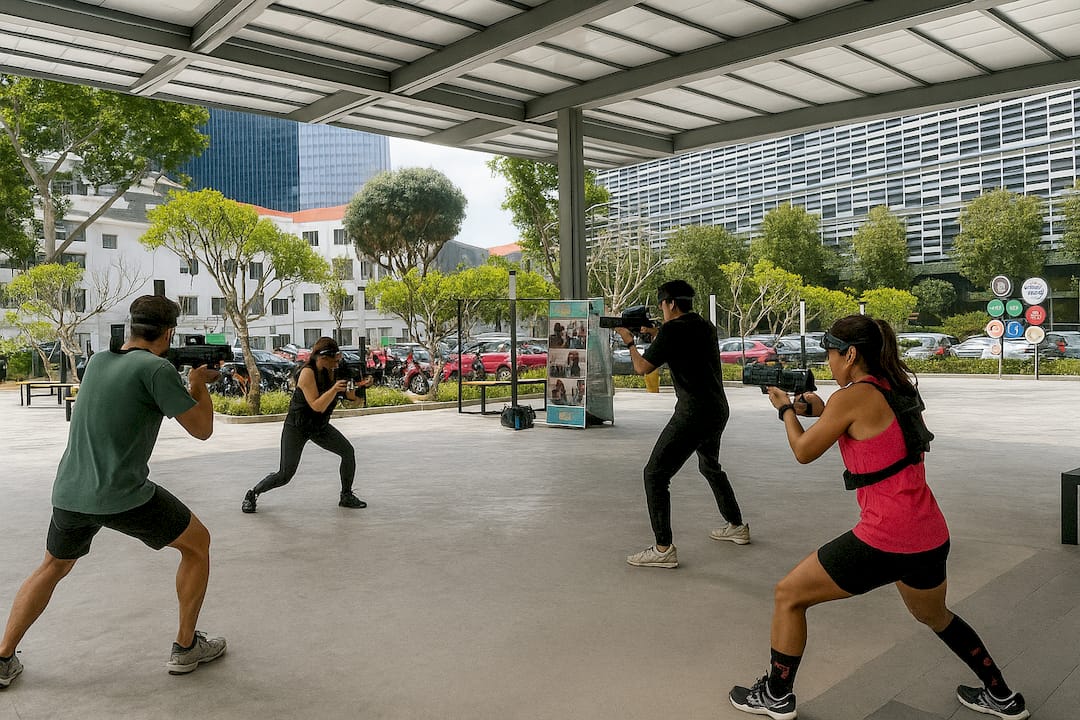
Why laser tag suits adult teams
Laser tag ticks almost every box above. The goal is clear (score for your team and complete the mission). The rules take two minutes to explain. Everyone plays at the same time, so nobody sits waiting. Teams form naturally, and the debrief writes itself: who covered whom, who went off alone, how the team changed plan when it was losing.
It also removes the awkwardness of many office games. Nobody has to share anything personal, and no one needs to be good at it. A finance manager and an intern wear the same vest. In a hybrid or multinational workplace, that equality matters.
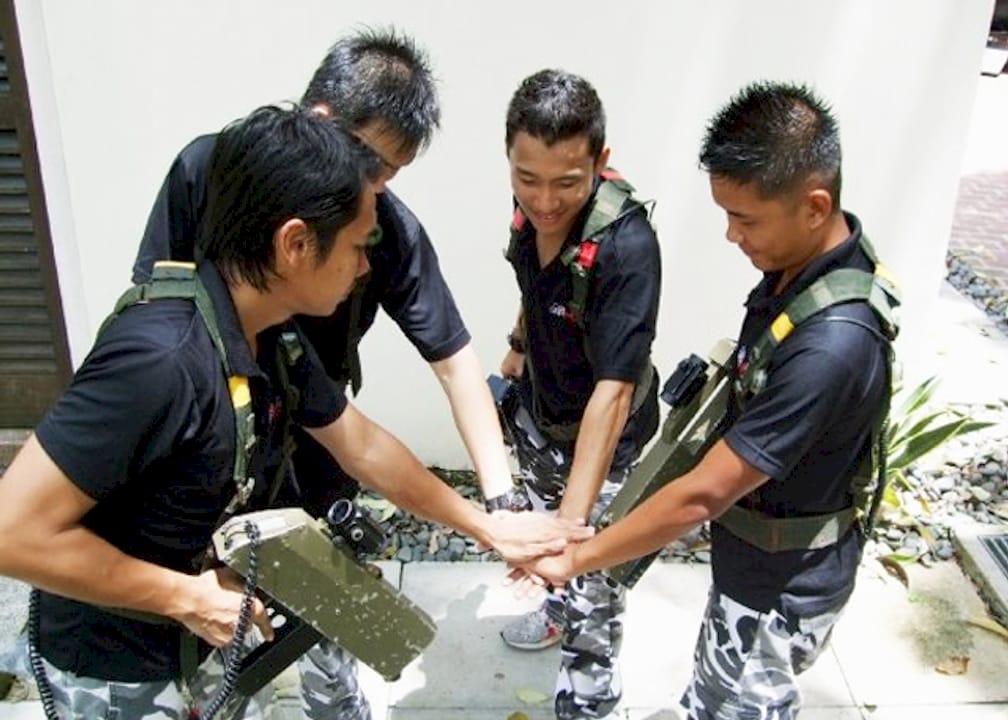
Our sessions use non-contact infrared technology, so there is no pain, no paint and no mess. Games can be set up for adults, mixed-age groups or families, and we customise the format, size, theme and mission. You can read more about the team outcomes of laser tag games and how laser tag enhances workplace teamwork.
Formats that suit work teams
- Team versus team. The simplest format, ideal for a department split in two, or for mixing colleagues across functions on purpose.
- Mission games. Teams complete objectives rather than just eliminating one another. These suit managers who want the debrief to touch on planning and role clarity.
- Large-group rounds. When you have a big headcount, we can organise rounds so everyone plays and the event runs to time. This suits schools, company carnivals and event planners.
- Mobile maze and obstacles. For carnivals and events, our laser tag mobile maze and carnival formats can be added to the mix, and inflatable obstacles are available to rent.
Where it happens
We come to you. Events are hosted at the venue you choose: an office, a school field, a park or a condo function room. All equipment, setup, facilitators and safety briefings are provided. For central business district teams who want a post-work session, see our page on laser tag in the CBD for team bonding.
Choosing by headcount, time and space
| Situation | What works | Why |
|---|---|---|
| 5 to 12 people, 15 minutes before a meeting | Two truths and a lie, common ground | No setup, quick to explain |
| 15 to 25 people, one hour | Tower challenge or blindfold guide in teams | Needs space and a facilitator |
| 20 to 40 people, half-day | Laser tag rounds with team mission games | Everyone plays at once |
| Whole school or company carnival | Laser tag mobile maze plus laser tag rounds | Scales to large crowds |
| Expat family day | Mixed-age laser tag | Players from age five upwards |
Whatever you choose, think about the weather. Singapore afternoons can turn to rain quickly, and an outdoor game with no indoor fallback can leave a whole event stranded. A format that can move from a field to a covered area or a hall keeps your day on track, and keeping a no-equipment game in reserve is a sensible habit.
Planning for expat teams and families
Singapore’s expat community often meets through work, school and condo life. That makes team bonding and family events overlap: the company family day, the school fun fair, the condo community weekend. Laser tag serves all of them, because our games are designed to be safe and inclusive for players from age five upwards. Children and adults can play in the same event, or in separate rounds.

For new arrivals, a shared game is a faster introduction than a networking drinks evening. People talk during play, and nobody has to start a conversation cold. If your office has recently grown with international hires, a session in the first few weeks of the quarter helps people settle in.
Planning for schools and event companies
If you organise carnivals, camps or large events, your main concerns are throughput, safety and a smooth schedule. Tell us your headcount, age range and venue, and we will plan formats and rounds around them. Our carnivals and events service covers schools, companies and event planners, and extras such as tents and inflatable obstacles can be added.
Rental extras are listed at these prices: one additional set of tents (5 pieces) at $100, four small inflatable obstacles at $100, eight small inflatable obstacles at $150, and one big inflatable obstacle at $50. Check the game prices page for the latest list.
Our view on team games
We started mobile laser tag in Singapore in 2005, and the lesson we have kept is that the best team game is the one nobody has to be talked into.
Desk games are useful, and we would use them to open a meeting. But when a team needs to leave the building mentally, a game where everybody runs, plans and talks at the same time does something a quiet icebreaker cannot. Colleagues who rarely speak end up shouting across a field to coordinate a flank.
That is why we bring everything to you: the equipment, the setup, the facilitators and the safety briefing. Your job is to choose the date and the venue. Ours is to make sure the youngest player and the most senior director both enjoy the game.
Joshua
Book a session for your team
Our fun shoot-outs are $45 per pax, and our team building and carnival formats are quoted on request. A booking deposit of $200 is required to confirm. Most of the planning is a conversation about your headcount, your venue and what you want the team to take away.
Read about corporate team building with laser tag or go straight to the pricing page to start planning.
FAQ
How long should an office team game last?
For a meeting icebreaker, five to ten minutes is plenty. For a team activity with a debrief, aim for 20 to 45 minutes. A laser tag session is a longer event, so plan it as a half-day or evening activity and ask us about package lengths.
Is laser tag suitable for adults and mixed-age groups?
Yes. Our games use non-contact infrared technology and are designed to be safe and inclusive for players from age five upwards. We customise the format for age, group size and mission, and every session starts with a safety briefing.
Can you run laser tag at our office or school?
Yes. We host events at your chosen venue, including offices, schools, parks, condos and homes. All equipment, setup and facilitators are provided.
What does a team session cost?
Our fun shoot-outs are $45 per pax. Corporate team building and carnival formats have no published price, so tell us your headcount and venue for a quote. The booking deposit is $200.