
The best party games for mixed ages share three traits: the rules fit in one sentence, a five-year-old and a 45-year-old start on equal terms, and nobody is knocked out early. Charades, Sardines, balloon volleyball and heritage games all pass that test. So does laser tag, which is why we bring it to condos, homes, parks, schools and offices across Singapore for guests aged five and above.
This guide is for parents and expat families hosting a birthday with cousins and grandparents, and for schools and event organisers who need something that works for a big, uneven crowd.
Key Takeaways
- Choose games that are explained in one sentence, can be joined halfway through, and keep every player in until the end.
- Level the field with handicaps, mixed teams and soft scoring rather than separate games for children and adults.
- Plan three to five short activities and alternate active with calm ones. Give non-players a job so no one sits out awkwardly.
- For large groups, run several zones or stations at once so queues never build.
- Non-contact infrared laser tag, run by facilitators at your own venue, gives a whole mixed-age group one shared game from age five.
Table of Contents
- What makes a game work for every age
- Calm games for flats and condo function rooms
- Active games for parks, playgrounds and big rooms
- Heritage games for grandparents and expat families
- Running games for large groups
- Putting a programme together
- Why laser tag works as the main event
- Book a session for your group
- FAQ
- Sources
What makes a game work for every age
Most party-game lists fail on the same point: they suit one age band and quietly lose the rest. A parent-tested list from Mommy Poppins names the features that fix this. Rules need one explanation, with house rules for little ones. Smart handicaps help, such as a five-second head start or extra chances for younger players. Teams should pair skilled players with beginners. A set timer keeps the game moving. Scoring can be generous, for example a younger child’s points counting double, or dropped altogether with a prize for everyone.
A Singapore bakery’s guide to mixed-age living-room games adds a practical test. A game travels across ages when it can be played from a seat, understood in a sentence and joined halfway through. Short rounds of about two minutes let a bored child wander off and back without breaking the game.
Use those three checks on any game before you commit to it:
- Can a newcomer join mid-round? If not, latecomers and wanderers get shut out.
- Is anyone eliminated? If so, the youngest or the least confident sit out first.
- Does skill beat everything? If so, add a handicap or mix the teams.
Calm games for flats and condo function rooms
Many Singapore parties happen in a HDB living room or a condo function room, where space is the limit. Seated and no-kit games help here.
- Charades. Split into two teams, act out a film, song or animal, and let the whole team guess. Younger players fit in because the guessing is shared, and a moderator can whisper gesture ideas to a child, as the Mommy Poppins list notes. It suits ages five and up.
- Sardines. One person hides and every finder squeezes in with them, so everyone ends up hiding together regardless of age. It needs no supplies, and the same list suggests 15 to 20 minutes for it.
- Freeze dance without elimination. Play music, pause it, and everyone freezes. Instead of knocking anyone out, award a cheer for the best pose. All you need is a phone and speaker.
- Two Truths and a Lie about the guest of honour. Each guest tells two true things and one false thing about the birthday person. Grandparents often win this one, and teenagers enjoy it too.
- Guess the baby photo. Ask guests to send an old photo in advance and have everyone match photo to person. It is a conversation starter for relatives who rarely meet.
Not everyone needs to play. The same bakery guide suggests handing non-playing guests a job: pouring drinks, holding the phone for the big reveal, or sitting with a grandmother who finds noisy games hard to follow. A teenager will often prefer to run the music and take photos. If a game flops, let it fade and move on to the food.
Active games for parks, playgrounds and big rooms
When you have more room, add games that burn off energy without punishing the slower movers.
- Sharks and Minnows. Mark a wide-open space with jump ropes. Tagged minnows become sharks, so little ones never feel “out”, according to Mommy Poppins.
- Freeze Tag. Adults can help unfreeze small children, which keeps both groups in the game.
- Flashlight Tag. Tagging is done with light, so younger children can “catch” faster older players. It works well at dusk in a condo garden.
- Treasure hunt. Pair older children with younger ones, or hide items that only little ones can reach.
If your group includes players with different physical abilities, the UK Scouts’ guide to adapting wide games gives practical ideas. Dodgeball can be played sitting down with mixed-ability teams, and nervous players can watch until they are ready. Games with balls can use bigger, lighter beach balls. Nests or targets can be raised onto tables for players who cannot bend, and wheelchair users need flat, even ground.
Heritage games for grandparents and expat families
Families living in Singapore, including expat households with visiting grandparents, often want something local that older relatives already know. Traditional kampung games fit well. Sport Singapore’s GetActive programme published a 57 Kampung Games guide of reinvented classics, including hopscotch, chapteh, congkak, bola relays and treasure hunts. It is designed to build movement skills in young children and encourage bonding between children, parents and guardians. One entry, Intergenerational Chapteh, uses homemade foam-board racquets and a net of flags, so parents, children and educators play together.
If some guests are older or frailer, the Agency for Integrated Care’s intergenerational guide is a good reference. It advises keeping each activity to 15 to 20 minutes before changing over. It also suggests simple adaptations: hold on to stable furniture or use palms instead of feet for chapteh, play football at walking pace, or use a penalty shoot-out with a larger goal.
Students have used the same approach at school. Fajar Secondary School had 120 Secondary Three students plan bingo and “eraser wars” for about 200 seniors, after first trial-playing the games with elderly residents. Testing a game with the oldest and youngest players before the event is a habit worth copying.
Running games for large groups
A game that suits eight guests at a table falls apart with 80 children at a school carnival or 200 people at a company family day. The fixes are structural:
- Run stations in parallel. Several activities at once mean no one waits in a long line. Spread them apart so queues do not merge.
- Create zones. Keep a children’s zone with games and inflatables, a calmer area with seating for adults and seniors, and food in between.
- Use a stamp card. Guests collect a stamp at each station and redeem a small prize at the end. It gives a shy child a reason to try everything.
- Plan for rain. At least part of the programme should be able to move under cover, since Singapore weather turns quickly.
- Decide the ending first. A bell, a music cue or the lights coming on tells everyone the round is over.
For schools, our school event ideas for large groups and party ideas for large groups pages go deeper on programme layouts. Event planners building a carnival floor can start with our carnival activities guide.
If your event splits guests into colour teams or houses, matching custom team T-shirt printing makes teams easy to spot and gives the day a sense of occasion.
Putting a programme together
A mixed-age party does not need ten games. Three to five, alternating loud and quiet, is enough. Here is a sample for a two-hour home or condo birthday with mixed generations:
| Time | Activity | Energy |
|---|---|---|
| 0:00 | Arrival game such as guess the baby photo | Calm |
| 0:20 | Sardines or Sharks and Minnows | High |
| 0:50 | Food and cake | Rest |
| 1:15 | Group activity such as laser tag in mixed teams | High |
| 1:50 | Charades or Two Truths and a Lie while guests wind down | Calm |
Keep the first game easy so latecomers can slip in, and save the most exciting activity for when everyone has arrived.
Why laser tag works as the main event
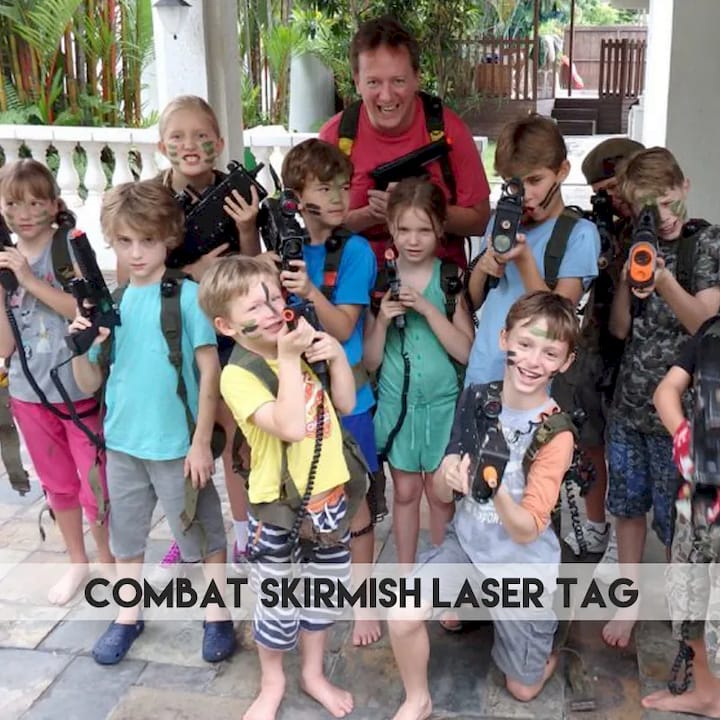
Laser tag is a natural answer to the problem this whole article is about. The goal is simple to explain: tag the other team and avoid being tagged. It is non-contact, using infrared technology rather than physical tagging. Teams can be balanced, so a parent and a ten-year-old can share a side. Game formats can be adjusted for age, group size, theme and mission. That is what lets one session serve a seven-year-old’s party, a family day with grandparents watching and a school carnival with hundreds of students.
For families, our family laser tag page shows how a session works, and our family day activities guide covers company events with relatives attending. For birthdays, see birthday party activities by age and venue.
Our view: one shared game beats five separate ones
We have run mobile laser tag in Singapore since 2005, and the lesson we keep returning to is that mixed-age parties go best when everyone plays the same game, not parallel ones for children and adults.
That is why we bring everything to your venue, whether a condo, home, park, school or office: the equipment, the setup, the facilitators and the safety briefing. Parents and event organisers can focus on their guests rather than on logistics.
Our games are customisable for age, group size, theme and mission format, and the infrared technology is non-contact, so play is safe and inclusive from age five upwards. A parent can be on the same team as their child, and a teacher can lead a house team of students.
If you pick only one headline activity for your party, pick one that every guest can understand in a minute and join with confidence.
Joshua
Book a session for your group
Our Kids Birthday Parties are priced at $30 to $35 per person, and Laser Tag Fun Shoot Outs at $45 per person. Inflatable obstacles and extra tents can be added: one big inflatable obstacle is $100 less than eight small ones at $150, at just $50, and four small ones are $100. A booking deposit of $200 confirms your date. Corporate team building, themed parties and carnivals are quoted by event, so tell us your headcount and venue. See the full game prices or our carnivals and events service.
FAQ
What are fun games for a mixed-age group?
Charades, Sardines, Sharks and Minnows, a treasure hunt and non-elimination freeze dance all work well. They have one-sentence rules and let younger and older players take part on equal terms. For a bigger moment, laser tag in mixed teams suits guests from age five.
How many games should I plan for one party?
Three to five is usually plenty. Alternate active games with calm ones, keep each to 10 or 15 minutes, and finish with the highlight activity when all guests have arrived. Leave gaps for food and chatting.
How do I keep older relatives involved?
Choose games that can be played from a seat, shorten the rounds and offer a role such as scorekeeper, photographer or team captain. Heritage games like chapteh or congkak, adapted to a gentler pace, are familiar to many older guests.
How do I run games for a school carnival or very large group?
Split the crowd across several stations and zones so nobody queues for long, and use a stamp card to guide children around. Keep the instructions short and have a wet-weather plan. Our school and carnival pages cover layouts for large groups.
Is laser tag safe for young children?
Our games use non-contact infrared technology, and each session includes a safety briefing from our facilitators. We run games for players from age five upwards, with formats adjusted to the age of the group.
Sources
- Mommy Poppins: 22 group games kids of all ages can play together
- Tings Bakery: party games for a mixed-age room
- Scouts: 9 wide games to get everyone up and moving
- GetActive Singapore: 57 Kampung Games
- Agency for Integrated Care: Intergenerational Guide
- CNA: Fajar Secondary students organise games with the elderly